
Introduction
In our previous article, we explored how quantum mechanics changed our understanding of physics and revealed that the universe does not behave in a fully predictable way at extremely small scales.
But within quantum mechanics, one concept stands out as especially strange:
Quantum superposition
According to this idea, a particle can exist in multiple possible states at the same time until it is observed or measured.
In some experiments, particles even behave as though they exist in two places simultaneously.
This may sound impossible from an everyday perspective, but quantum superposition is one of the most important principles in modern physics and has been repeatedly supported by experiments.
If you are new to quantum physics, you can first read our introduction to quantum mechanics to better understand the foundation behind these ideas.
What Is Quantum Superposition?

Quantum superposition is the idea that a quantum system can exist in multiple possible states simultaneously before measurement.
In classical physics, objects exist in one definite condition at a time.
A switch is either on or off.
A train is either moving or stationary.
Quantum particles, however, do not always behave in such definite ways.
Before observation, a particle exists as a combination of different possibilities rather than one fixed state.
Only when measured does it appear in one specific condition.
This is one of the key differences between classical physics and quantum mechanics.
A Simple Way to Understand Superposition

Imagine a spinning coin.
While it is spinning, you cannot clearly describe it as heads or tails. It exists in a temporary mixed state until it lands.
Quantum superposition is somewhat similar, but significantly more profound.
An electron is not simply “unknown” before measurement. According to quantum mechanics, it genuinely exists in multiple possible states simultaneously.
This is not just a mathematical trick or philosophical idea. It is supported by real experimental evidence.
The Double Slit Experiment
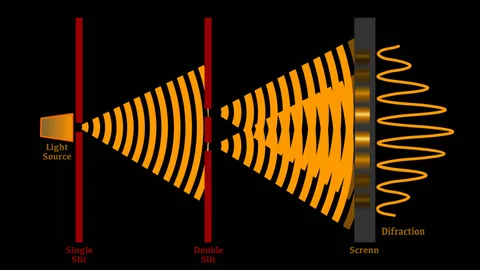
One of the most famous demonstrations of quantum superposition is the double slit experiment.
Scientists fired electrons toward a barrier containing two narrow slits.
If electrons behaved like ordinary particles, each electron should pass through only one slit and form two simple lines behind the barrier.
But that is not what happened.
Instead, the electrons created an interference pattern similar to waves in water.
Even more surprising, this pattern still appeared when electrons were fired one at a time.
The results suggested that each electron behaved as though it passed through both slits simultaneously.
However, when scientists placed detectors near the slits to observe the electron’s path, the interference pattern disappeared.
The electron suddenly behaved like a normal particle again.
This experiment became one of the strongest pieces of evidence that quantum systems behave differently when measured.
Why Quantum Superposition Feels Impossible
Quantum mechanics conflicts with the way humans naturally experience reality.
In everyday life, objects have clear positions and predictable behavior. We never see a car existing in multiple locations at once.
At the quantum level, however, nature operates through probabilities and possibilities rather than certainty.
Particles do not appear to possess one fixed state before interaction or measurement.
This is why quantum superposition feels deeply counterintuitive, even to many physicists.
Schrödinger’s Cat and the Problem of Observation
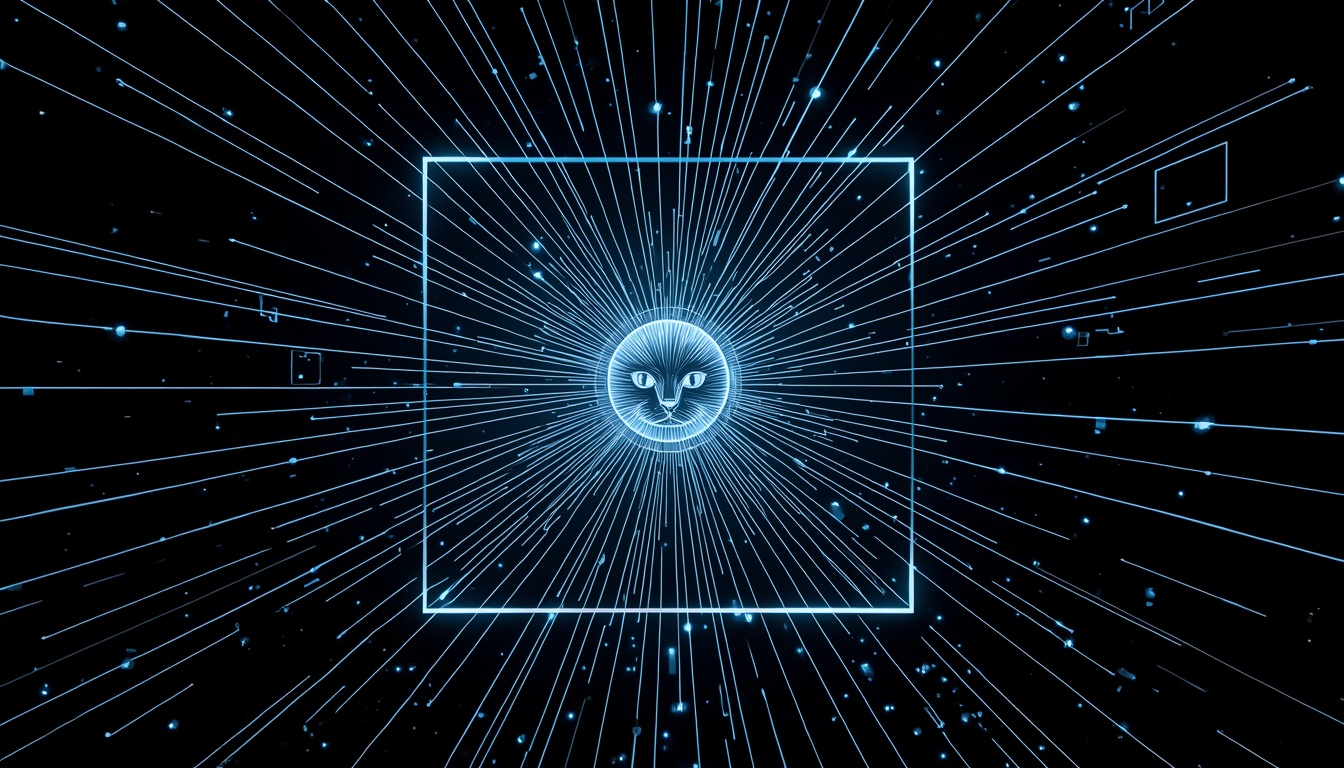
To demonstrate how strange quantum mechanics appears, physicist Erwin Schrödinger proposed a famous thought experiment.
Imagine a sealed box containing:
- A cat
- A radioactive atom
- A poison mechanism
If the atom decays, the poison is released and the cat dies.
If the atom does not decay, the cat remains alive.
According to quantum mechanics, the atom can exist in both states simultaneously before observation.
Which means the cat is mathematically both alive and dead until the box is opened.
Schrödinger designed this paradox to highlight how unusual quantum superposition becomes when applied to large-scale objects.
Why Quantum Superposition Matters
Quantum superposition is not just a theoretical curiosity.
It forms the foundation of several advanced technologies, including:
- Quantum computing
- Semiconductor systems
- Lasers
- MRI technologies
Quantum computers, in particular, use superposition to process multiple possibilities simultaneously, potentially solving problems that would be extremely difficult for classical computers.
As research advances, quantum principles may also influence future aerospace systems, secure communications, navigation technologies, and next-generation computing architectures.
Can Large Objects Exist in Superposition?
In theory, quantum mechanics applies to all physical systems.
However, large objects constantly interact with their surroundings. These interactions rapidly destroy delicate quantum states through a process known as decoherence.
This is why superposition can be observed in tiny particles but not in everyday objects such as humans, vehicles, or planets.
The larger and more complex a system becomes, the more difficult it is for superposition to survive.
Conclusion
Quantum superposition reveals that reality behaves very differently at the smallest scales of nature.
Instead of existing in one definite condition, quantum particles exist as a range of possibilities until measurement occurs.
Although this idea challenges human intuition, decades of experiments continue to support it with extraordinary accuracy.
Superposition suggests that reality at its deepest level may not be completely fixed until interaction takes place.
And if that is true, then the universe may be built not from certainty, but from possibilities.
About SVM Aero
Shankara Vihangam Aerospace (SVM Aero) is an emerging aerospace initiative focused on advancing India’s aviation and space future through research, exploration, and knowledge sharing.
As part of this mission, we publish educational and research-backed content covering physics, aerospace engineering, future technologies, and the mysteries of the universe.